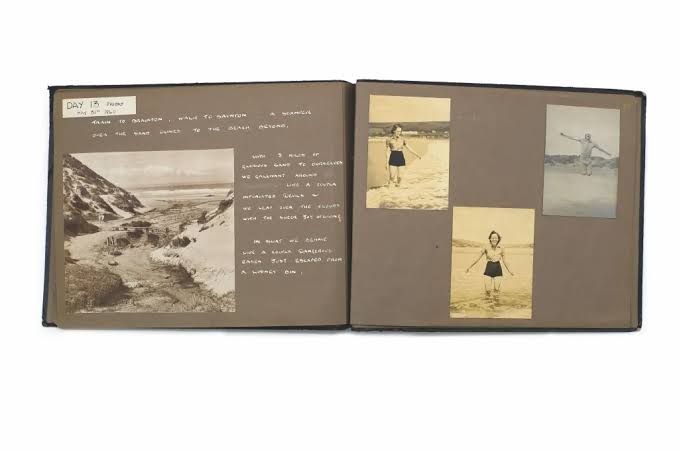
A small photograph album of an unknown couple on holiday in North Devon; beautifully illustrated with captions, cartoons, memorabilia and photographs.
My corner of the world, I recognise so much. A holiday hike through Linton and Lynmouth, stranded in Ilfracombe with bad weather (nothing changes), then on to Instow and finally to my home town Barnstaple.
And yet, behind the scenery and smiles, look closer…
The year was 1940, at the time of the evacuation from Dunkirk.
The painful juxtaposition between these joyful photos on the beach and our troops stranded on the foreign beaches of Northern France, wading waist deep through the water, is incredibly poignant.
And this couple, in all their innocence, are not left untouched by the hand of history. By chance, they come across a copy of the Daily Express – the headline screams: ‘Allied Army Cut in Half’.
Then, the war is brought into their B&B by radio: ‘the 9 o’clock news is grim. The channel ports have fallen. Invasion is imminent. Coast towns are being evacuated.’
They travel to Instow by bus and then walk along the estuary to Barnstaple but notice that, as they walk, ‘signposts on the way are disappearing’. (These were being deliberately removed to confuse low flying German airmen and remained absent for the rest of the war.)
With those signposts, so much else disappeared – safety, security, innocent holiday fun. A private album for personal remembrance starts to become a record of social history happening in real time.
No one wrote about this uncomfortable juxtaposition in the context of WW2 better than the British-American poet W. H. Auden – the gap in experience (and the blurring of that gap) between the civilian and the solider, the artist and the man of action. I immediately thought of his poem “September 1, 1939” written as Germany invade Poland, the poet sitting in a ‘dive bar’ on Fifty-Second Street. The weight of the coming war ‘obsessing our private lives’.